New Age Tarot, Clairvoyants & Psychics
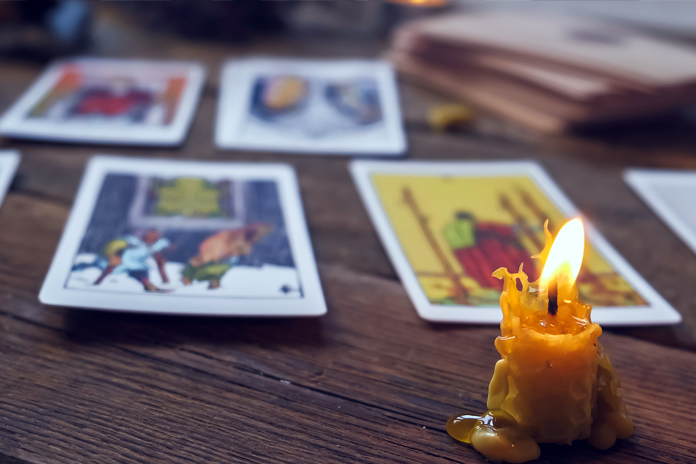
Tarot is having a renaissance. Though the origin of the Tarot is forever lost to us in the mists of time, the Tarot is always evolving. New Age Tarot practioners, such as myself, are breaking out of the old school rigidity of formal spreads, ritual and routine. Though I have massive respect for the Tarot and strive to include the ancient meanings in my readings, the way I have started interpreting the cards has been evolving for many years.
Find Your own Tarot path, If you take the same route, you will always arrive at the same destination!. There are 78 Tarot cards that can be upright or reversed, multiply this by the number of cards in your chosen spread & the possibilities are endless. Many people experience similar life events, love affairs break down, unexpected events throw us a curve ball, etc. Therefore it is vital to constantly challenge yourself in your readings and constantly search out additional nuances in the cards.
Clairvoyance & Intuition is at play with many of my top psychic readers. I have spoken to many Psychic readers & Excellent Clairvoyants who use Tarot, though mainly as a prop to fire their intuition. People often search for trot reading near me before they land on these pages. They are searching for readings or more information on Tarot & other forms of divinatory tools, however I think Tarot is again becoming the most popular form of psychic tool for the modern reader..
The Origins of The New Age Movement
Although many people consider New Age philosophy to be a fairly recent innovation in Western thought, the movement actually has its roots as far back as prehistoric times. For instance, astrology first began to be explored during the Stone Age when human beings began to record the effects of the moon on bodies of water. Other components can be found in the works of authors such as Alice Bailey and Godfrey Higgins. Another component can be found in European playing cards that gained popularity during the latter part of the 14th century. Known, of course, as Tarot cards, they were not widely used by mystics until the 18th and 19th centuries. Other origins include the formation of Theosophical Society, which was a movement started by a Russian woman named Helena Blavatsky that combined parts of Eastern philosophy with elements of Western spirituality and the work of Franz Mesmer with magnets as healing tools during the 17th century. the first recorded usage of the term “New Age” was in 1809 in a preface written by George Blake to a book of poetry composed by John Milton.
New Age philosophy really didn’t take hold in Western Society until the 1960s. The Esalen Institute in Big Sur, CA, was developed in 1962 and had a substantial impact on interest in Eastern philosophies among U.S. residents. The 60s were a time of social unrest, particularly among young people, and it was common for those seeking answers to the mystery of life to explore religions and philosophies other than the ones that they had grown up with.
Popular culture also played a substantial part in bringing the New Age movement to the notice of mainstream America. In 1967, “Hair: The American Tribal Love-Rock Musical” opened its first act with a song including the line “this is the dawning of the Age of Aquarius.” Small, locally owned metaphysically-oriented bookstores and cafes began opening in U.S. communities across the nation during the 1970s, and a popular publication brought the term into common usage.
The appeal of this type of philosophy is its highly personal nature. Every person finds his or her own spiritual path and is encouraged to search according to their own individual needs and desires. This movement has achieved significant status in mainstream American culture and shows no sign of slowing down. In fact, it’s growing more quickly than traditional religions in many parts of the world.