
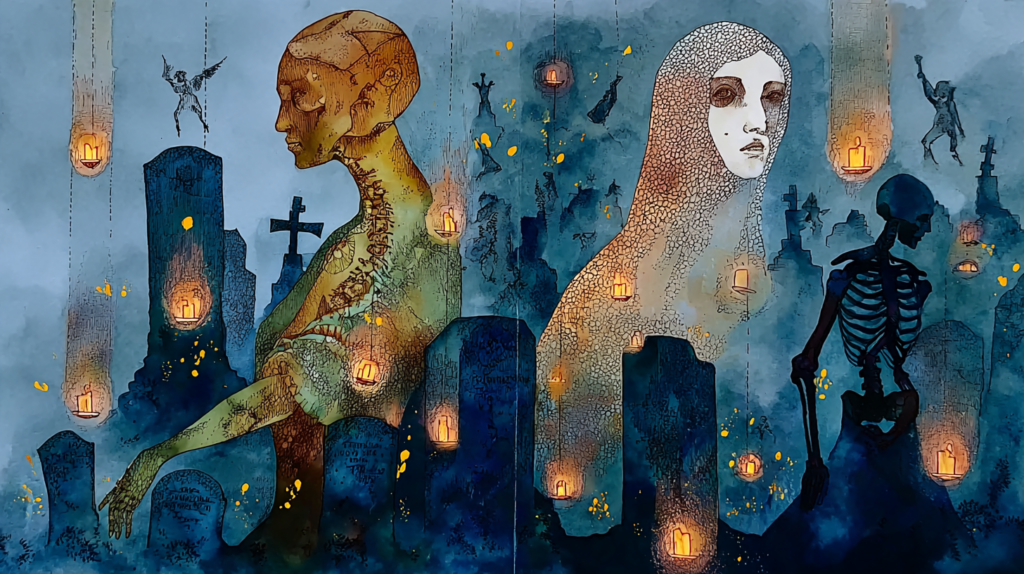
Most people think Halloween ends at midnight on the 31st. It doesn’t. Halloween is only the doorway. Behind it lie two more days that, for well over a thousand years, people across Britain, Ireland and Europe kept as a time to remember their dead. Together, those three days have a name that has almost been forgotten: Allhallowtide.
I’ve always felt this stretch of the year more strongly than any other. The nights draw in, the leaves come down, and the old stories feel very close to the surface. Allhallowtide is the old name for that feeling.
Allhallowtide, also called Hallowtide, is the three-day season running from 31 October to 2 November:
“Tide” here is the old word for a season, the same as in Christmastide or Eastertide. So Allhallowtide simply means the season of the hallows.
“Hallow” is an old English word for a holy person or saint. We still hear it in the Lord’s Prayer (“hallowed be thy name”) and in Hallowmas. The night before All Hallows’ Day was All Hallows’ Even, and over the centuries that was squeezed down to Hallowe’en, and finally Halloween.
So every time someone says “Halloween”, they’re quietly naming the eve of a feast for the holy dead, whether they know it or not.
All Saints’ Day is a Christian feast honouring every saint, including the countless faithful people who were never officially named. Its date goes back to the eighth century, when Pope Gregory III dedicated a chapel in St Peter’s in Rome to all the saints and fixed the feast on 1 November. About a hundred years later, Pope Gregory IV encouraged its observance across the wider Church, and Emperor Louis the Pious made it official throughout his empire in 835.
In Britain it was known as Hallowmas, and it was important enough to turn up in everyday speech. Shakespeare mentions a beggar whining “at Hallowmas” in The Two Gentlemen of Verona, which tells you how familiar the custom of asking for alms at this time of year already was.
If All Saints’ Day is for the famous dead, All Souls’ Day is for everyone else: our grandparents, our friends, the people whose names only we still remember. The day was set by Odilo, abbot of the great monastery of Cluny in France, who around the year 1000 asked his monks to pray for all the departed on 2 November. The practice spread from monastery to monastery and eventually across the Western Church.
Across Europe, families still visit graves on these days, clean and decorate them, and light candles there. In Mexico the same two days become Día de los Muertos, with altars, marigolds and the favourite foods of the dead laid out to welcome them home.
One of my favourite Allhallowtide customs is souling. In England and parts of Ireland, poor people, and later mostly children, went from door to door during Allhallowtide asking for soul cakes: small spiced buns or biscuits, often marked with a cross. In return, they promised to pray for the household’s dead. Each cake given was said to help a soul on its way.
The soulers sang as they went. The antiquarian John Aubrey recorded one of their rhymes in the seventeenth century:
A soul-cake, a soul-cake,
Have mercy on all Christians for a soul-cake.
Knocking on doors in the dark, asking for a treat and offering something in return: it isn’t hard to see trick-or-treating in there, many centuries before the plastic pumpkin buckets.
Long before any of this, the Gaelic world marked Samhain at the same time of year: the end of the harvest, the start of the dark half of the year, and a night when the boundary between the living and the dead was believed to grow thin. It’s one of the eight festivals on the Wheel of the Year.
You’ll often read that the Church moved All Saints’ Day to 1 November to replace Samhain. The truth is less tidy, and historians still debate it. The date seems to have been settled in Rome, far from Celtic lands. What is clear is that, on the ground, the two traditions met and mingled. The bonfires, the guising, the sense of the dead walking close by and the Christian prayers for the departed all ended up sharing the same few nights. Our Halloween is the child of both.
You don’t need to be religious to feel the pull of these days. Here are some simple ways to mark them:
If the Death card turns up at this time of year, don’t be frightened. It rarely means a physical death. It speaks of endings that make room for something new, which is exactly what Allhallowtide is about.
Allhallowtide falls early in Scorpio season, the sign of death, rebirth and everything hidden beneath the surface. It’s fitting. This year the New Moon in Scorpio follows early on 9 November, at 16° Scorpio, a natural moment to let go of what has ended and set an intention for what comes next.
If you’d like to know what the dark half of the year holds for you, my trusted readers are available by phone, seven days a week.
However you mark it, I wish you a peaceful Allhallowtide, and a little candlelight to see you into the dark half of the year.
✦ Go Deeper ✦
The cards and the stars open the conversation. A live reading with one of our experienced readers takes it further — personal, private, and specific to you.
From £15 for 10 minutes · 18+ only · For entertainment purposes